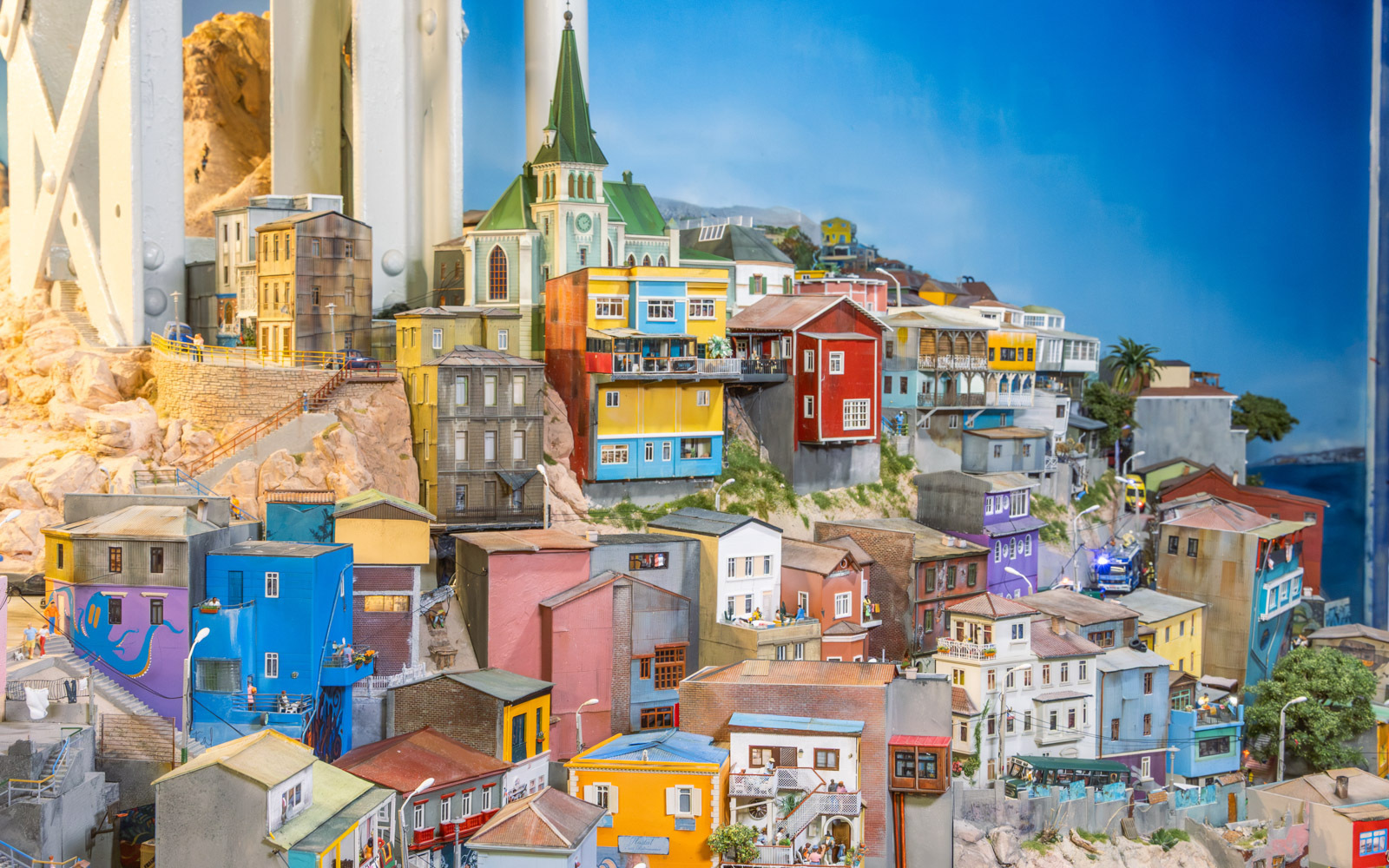
For Valparaíso, we took a different approach: unlike recent practice, the city wasn't completely pre-drawn digitally on a computer. Instead, the streets served as a baseline, and the city grew step by step by hand—just as organically as the Chilean original. Based on photos taken on site and Google Maps research, panels with individual window cutouts were drawn, printed, hand-cut, and assembled to create crooked, irregular facades of wood and sheet metal. To accommodate the steep hills, the buildings were staggered with clever offsets. The characteristic street art made its way onto the walls via waterslide decals: printed graffiti motifs were released in a water bath and now hug every single stone perfectly.
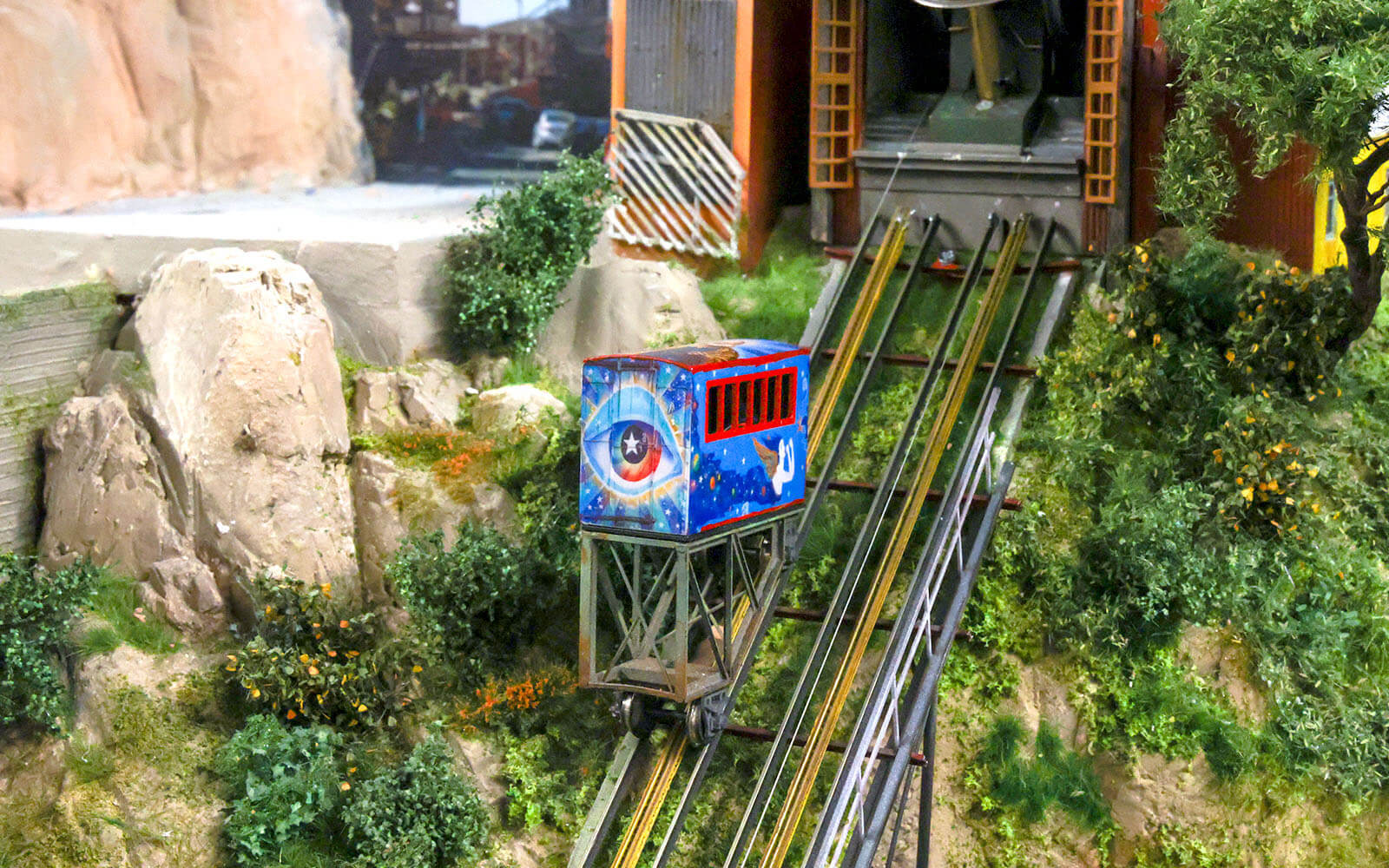
An absolute highlight are the historic funiculars (Ascensores), which tackle gradients of 45 to 50 degrees. The delicate brass cable car frame was soldered by hand. The drive mechanism uses repurposed parts from our locomotive workshop, such as old steam train wheels. Contacts on the rails pick up power for the gondola lighting, and the slight, intentional flickering lends the ride a nostalgic charm. Because the funicular is subject to heavy wear in continuous operation, a long-term repair solution was required: the entire wooden frame, including the buildings, rails, and mechanics, was designed as a separate module. It can be lifted out of the layout completely with just four screws whenever maintenance is needed. Valparaíso is thus a perfect combination of artistic freedom and well-thought-out engineering.